

North American financial markets continue to navigate a collection of unresolved conflicts. The US war with Iran persists, Canada and the US remain locked in a trade dispute, and the world’s largest technology companies are in an arms race on Artificial Intelligence (AI). While these issues are very different, they increasingly share a common characteristic: continuing is costly, but nobody wants to be the first to back down.
The US war with Iran remains the most immediate source of economic uncertainty. Neither side wants to make concessions to bring the conflict to an end. For investors, the greatest impact remains higher energy prices. While attention naturally focuses on the price of crude oil, the cost of refined products, such as diesel, has risen even more significantly (Figure 1).
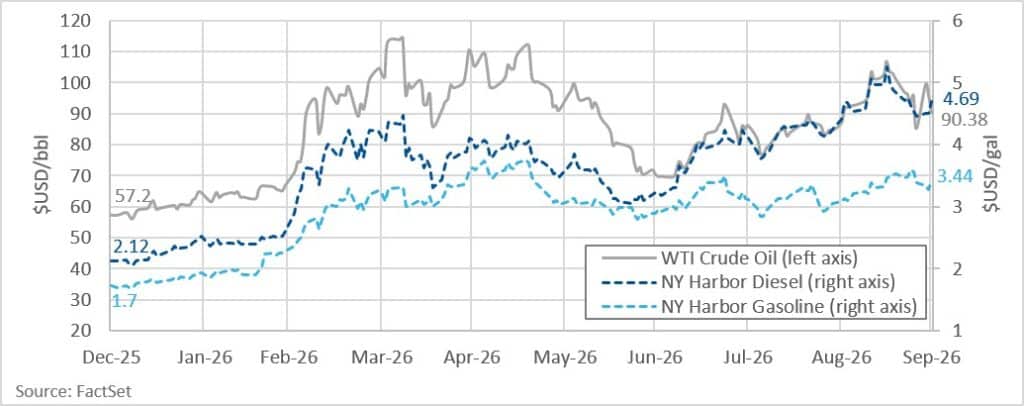
The increase in diesel prices has been amplified by unusually wide refining margins, or “crack spreads.” These spreads are the difference between the price refiners pay for crude oil and the value of the products they produce. Along with restricted energy flows through the Strait of Hormuz, escalations in the Russia-Ukraine war have made refineries a target. When refining capacity is constrained, the price of refined products, like diesel, can rise considerably more than crude oil itself. Diesel is essential to transportation, agriculture, mining and construction. If sustained, these pressures risk more persistent inflation, which will weigh on the broader economy.
Canada faces a different kind of standoff with the United States. The relationship between the two countries has deteriorated following President Trump’s decision to impose tariffs and pursue a confrontational approach. Canada has retaliated with its own tariffs. Businesses in both countries are facing greater uncertainty. The economic incentives still favour cooperation as decades of integrated supply chains cannot easily be recreated elsewhere. But reaching an agreement has become increasingly difficult.
The longer the dispute continues, the greater the incentive for Canada to reduce its dependence on the US. This adjustment will be neither quick nor easy, as an increasingly hostile neighbour is making trade diversification a necessity rather than a choice. But that necessity may also prove constructive. It has already created greater urgency in improving Canada’s own investment climate with an emphasis on building major projects at home.
Perhaps the most consequential standoff for financial markets is occurring in AI. The world’s largest technology companies continue to spend extraordinary amounts building data centres and purchasing the equipment to fill them. Questions about whether these investments will generate adequate returns have grown alongside spending, but have done little to slow it. A company that reduces AI investment today may protect margins and preserve capital. If competitors do the same, that decision may prove sensible. But if competitors continue spending and AI produces the benefits many hope, that company risks becoming irrelevant. The cost of continuing may be enormous, but the cost of falling behind is perceived to be far greater.
AI is hardly alone in its growing appetite for capital. Governments are borrowing heavily, while enormous amounts of financing will be required for everything from energy infrastructure and defence spending to social programs and rebuilding war-torn areas. At the same time, persistent inflation has made investors less willing to provide capital at the exceptionally low rates that prevailed for much of the past decade. The result has been a meaningful rise in bond yields (Figure 2). For fixed-income investors, this adjustment has been painful. Bond prices move inversely to yields, meaning higher interest rates have reduced the value of existing bonds.

But higher yields also create opportunities. As existing bonds mature, the proceeds can be reinvested at more attractive rates, offering better future fixed-income returns. We have been positioned for this adjustment by intentionally keeping client bond portfolios with shorter maturities. This has allowed us to avoid much of the painful repricing while waiting for more attractive opportunities, like those we are seeing now.
As with all conflicts, eventually someone will have to blink. Until then, our focus is on owning high-quality businesses capable of navigating a wide range of outcomes. Rather than attempting to predict how and when each standoff will end, we continue to carefully weigh potential returns against the risks involved. We remain cautious and focused on opportunities where long-term fundamentals are intact, and valuations provide an appropriate margin of safety.